

A property enquiry is not a viewing, and a viewing is not a sale. Yet many UAE real estate campaigns still send Google Ads only one useful signal: somebody submitted a form. The sales team learns what happened next; the advertising account often does not.
Enhanced conversions for leads can help connect eligible website enquiries with later CRM outcomes. For an Abu Dhabi brokerage or a Dubai project team, the practical goal is to distinguish qualified buyers from duplicate, unreachable or unsuitable enquiries before making the next budget decision.
Why review your conversion tracking now?
Google’s 18 September 2026 lead-generation update puts first-party data and closed-won outcomes at the centre of its measurement discussion. It also describes lead intent scoring as a pilot. Do not build a campaign plan around assuming that pilot is available in your UAE account.
This guide focuses on the measurement work your team can assess today, rather than on the bidding features themselves. If you need to agree what a good enquiry means first, start with our UAE real estate lead quality scorecard.
What enhanced conversions for leads actually does
Google describes enhanced conversions for leads as an extension of offline conversion imports. It uses first-party customer information, such as a hashed email address, alongside eligible conversion data to help match a later outcome to an earlier advertising interaction. Keep existing Google click identifiers where available.
It does not qualify the buyer for you. A sales agent still needs to record a meaningful outcome, and somebody needs to maintain the connection between the website, CRM and advertising account.
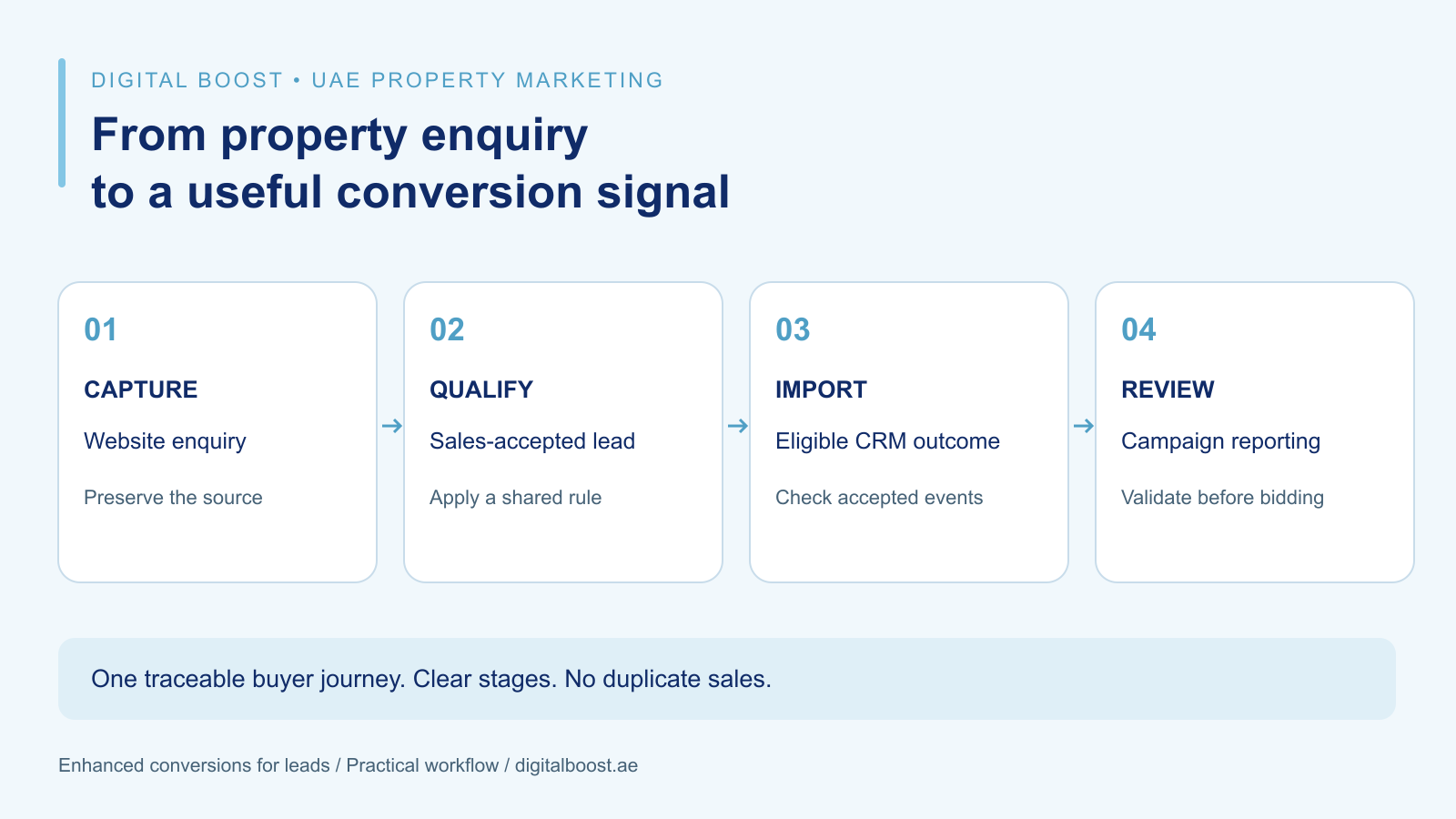
Define one sales milestone before connecting anything
For a first implementation, choose a milestone that agents can record consistently. Our recommendation is a sales-accepted enquiry: a real person has been contacted, their requirement is understood, and the agent has confirmed a plausible match with current inventory.
- Abu Dhabi end-user enquiry: record the preferred community, property type, broad budget range and intended move date.
- Dubai off-plan enquiry: distinguish an information request from a buyer who has discussed the payment plan and purchase timeline.
- Overseas enquiry: record the time zone and next agreed conversation, rather than marking every unanswered local-hours call as a poor lead.
These are proposed operating definitions, not market benchmarks. Keep the qualification rule written down so that two agents would classify the same enquiry in the same way.
Build a clean hand-off from form to CRM
Map the enquiry journey before switching on an import. Which form created the record? Did the landing page preserve the campaign source? Does the CRM have one record for the buyer or several copies? Can the team identify when the qualification event actually happened?
Give each enquiry a stable internal ID. Store the original source, the relevant project or community, the assigned agent, the stage and its timestamp. Keep the same identity across follow-up activity instead of creating a new buyer every time the person returns.
For UAE phone numbers, check international formatting and do not silently add +971 to genuine overseas numbers. Ask your implementation team to follow the connector’s normalization and hashing requirements. Never place raw email addresses or phone numbers in page URLs.
Choose an import route your team can maintain
Google Ads Data Manager provides a point-and-click way to connect supported sources and manage data destinations. Check your actual CRM and connector support before choosing between a native integration and an API implementation.
Existing custom imports deserve particular attention: Google’s current enhanced-conversions documentation flags a migration toward the Data Manager API, with legacy access conditions. Ask your developer to confirm the route in use and inspect recent successful uploads. A CRM dashboard that says “connected” is not proof that Google accepted yesterday’s events.
Validate before changing campaign optimisation
Google’s implementation checklist recommends initially keeping the new conversion action secondary for two to three weeks. It also calls for regular imports, accurate event times, duplicate controls and review of diagnostics.
Use that observation period to reconcile a small sample end to end. Confirm that the website record reached the CRM, the intended stage was recorded, the upload was accepted, and reporting reflects the expected conversion action. Investigate discrepancies before using the new signal for bidding.
Do not treat every stage as an independent sale. One buyer who submits a form, books a viewing and reserves a unit should remain traceable as one journey. Keep operational reports for each stage, then decide deliberately which outcome the campaign should optimise toward.
Keep WhatsApp and portal enquiries in perspective
A WhatsApp-button click is not proof that a conversation happened. Likewise, a Property Finder or Bayut enquiry should not automatically be reported as a Google Ads conversion. Preserve each source and use only the eligible attribution and import workflow for that record.
The CRM can provide a combined management view without claiming that one channel generated every customer. That distinction matters when comparing your paid media, website and property portal marketing activity.
Handle customer data deliberately
Review Google’s customer data policies, your privacy disclosures and the permissions required for your collection and sharing practices. Hashing is a technical safeguard; it is not a substitute for the applicable requirements. Keep unnecessary documents and personal notes out of advertising uploads.
Frequently asked questions
Will this immediately reduce cost per lead?
No immediate reduction is guaranteed. First establish that measurement is accurate. Evaluate cost per sales-accepted enquiry and progression to viewings alongside raw enquiry cost.
Should a brokerage optimise only for closed deals?
Not automatically. A small number of delayed sales may be a difficult initial signal. Review volume, delay and consistency with your campaign specialist before selecting the bidding goal.
Find the gap between your ads and your sales pipeline
Digital Boost helps UAE property teams connect campaigns, landing pages and lead follow-up. Book a strategy call to review your conversion journey. Bring your CRM stage definitions, current conversion-action list and an anonymised example of an enquiry that became a viewing. We can help identify what is missing before you increase spend.
Published 6 October 2026. Platform guidance checked on this date. Recommendations are an operational framework, not a guarantee of campaign results.